
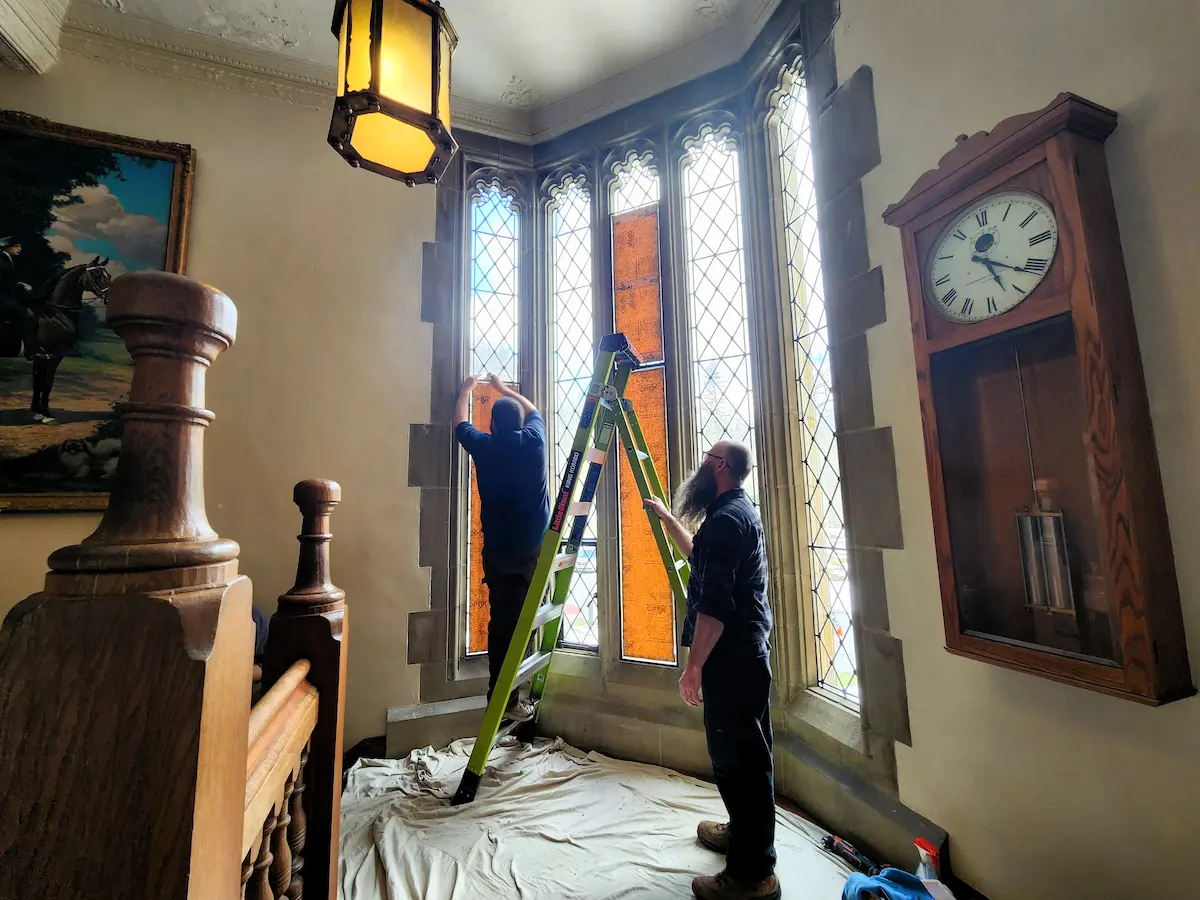
It may come as a surprise that one of the greatest adversaries to historic artifacts, artwork, furniture and collections–is light. Meadow Brook Hall has installed custom ultraviolet (U.V.) light blocking acrylic panels as part of an IMLS (Institute of Museum and Library Services) grant to preserve, protect and maintain Meadow Brook Hall and its collections from light damage.
Senior craftsmen from Omnibus Studios constructed and installed 10-foot-tall U.V. blocking panels on the south-facing side of the historic house. The team’s stone carver fit 12 total panels into place, by carefully drilling into the historic limestone tracery to secure the preservation system.
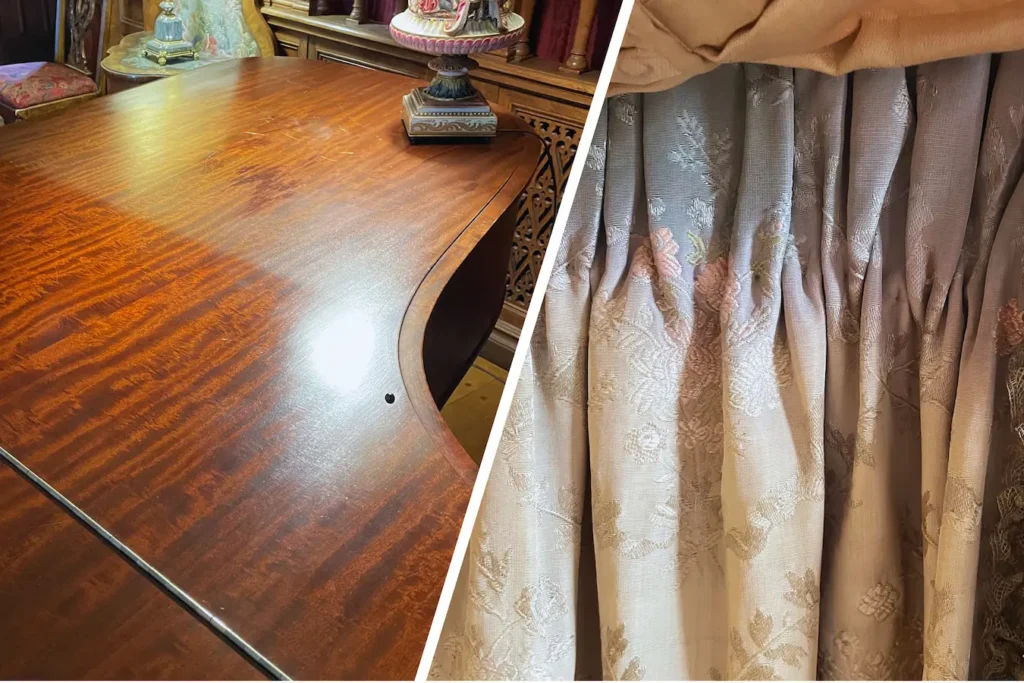
“The U.V. light blocking panels are an important addition to our work preserving Meadow Brook Hall for generations to come,” said Meadow Brook Curator Madelyn Chrapla. “There are so many factors that go into caring for our more than 75,000 artifacts, and something that many people do not consider is the harmful effect of light on the delicate and historic objects and furnishings inside the historic mansion. We are so excited to have these U.V. panels installed. They are incredibly discreet and effective and we are grateful for this chance to protect our collections.”
The custom panels – made of clear U.V.-blocking acrylic and framed in patinaed metal to match the historic bronze frames – will block 99 percent of ultraviolet light, protecting valuable paintings, ornate woodwork, textiles, and interior finishes from long-term sun damage.
Ultraviolet light can damage artwork by breaking down the chemical bonds in pigments, dyes, and organic materials through photochemical action. This leads to fading, color shifts, yellowing, and structural weakening of materials like paper, textiles, and paint.
Three senior craftsmen will be on site fitting the panels into place, including a skilled stone carver who carefully drilled into the historic limestone tracery to secure the preservation system.
Meadow Brook’s collection of more than 75,000 artifacts includes original paintings, sculptures, prints and drawings, furniture, ceramics, carpets, glass, silver, costumes and antique textiles, family archival materials, and Dodge Motor Car Company memorabilia. Highlights include Tiffany art glass, costumes by Paul Poiret, Stickley furniture, paintings by Sir Joshua Reynolds, Sèvres and Meissen porcelain, and Rookwood pottery.
This expansive collection requires expert care and conservation. You can support our efforts by making a gift toward Collections Care and Conservation. For more information, visit meadowbrookhall.org/support.
See Preservation in Action
Watch the reel below to see Meadow Brook Curator Madelyn Chrapla discuss the importance of protecting the collection from light damage.
About Meadow Brook Hall
MEADOW BROOK HALL is the historic home built by one of the automotive aristocracy’s most remarkable women, Matilda Dodge Wilson, widow of auto pioneer John Dodge, and her second husband, Alfred Wilson. Constructed between 1926 and 1929, Meadow Brook Hall represents one of the finest examples of Tudor-revival style architecture in America, and is especially renowned for its superb craftsmanship, architectural detailing and grand scale of 88,000 square-feet. It was the center of a country estate that included 1,400 acres, numerous farm buildings, recreational facilities, several residences and formal gardens. Named a National Historic Landmark in 2012, MEADOW BROOK HALL strives to preserve and interpret its architecture, landscape, and fine and decorative art so that visitors may be entertained, educated and inspired by history. Meadow Brook Hall is located in Rochester, Mich. on the campus of Oakland University.
About IMLS
The Institute of Museum and Library Services is the primary source of federal support for the nation’s libraries and museums. We advance, support, and empower America’s museums, libraries, and related organizations through grantmaking, research, and policy development. IMLS envisions a nation where individuals and communities have access to museums and libraries to learn from and be inspired by the trusted information, ideas, and stories they contain about our diverse natural and cultural heritage. To learn more, visit www.imls.gov and follow us on Facebook and Twitter.
About Omnibus Studios
Omnibus Studios, an offshoot of Detroit’s historic Maglia Studios, was uniquely positioned to undertake the intricate work. The studio’s founders apprenticed under master stained-glass artist Andrew Maglia beginning in 1973, mastering the rare and ancient techniques of glass painting, lead caming, and delicate soldering used in historic European window assembly. Those skills allowed the team to meticulously recreate detailed faces, hands, costumes, and diamond-pane patterns across six upper façade window areas and eight curved windows – each rebuilt on a custom curved form.
